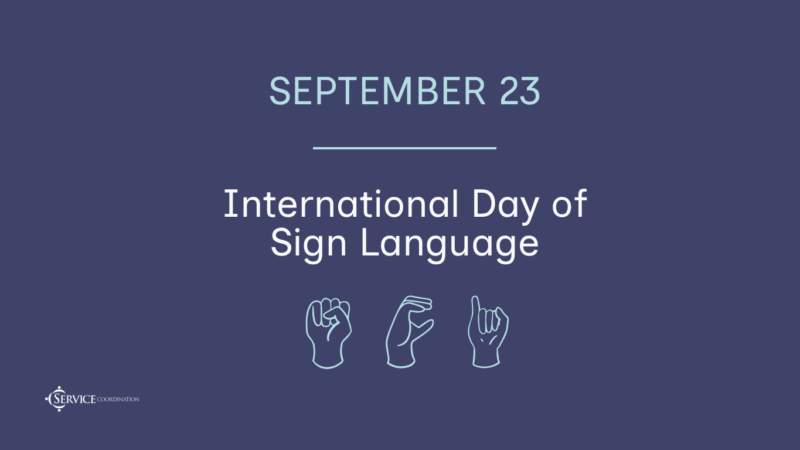
Each year on September 23, International Day of Sign Languages recognizes the importance of sign languages in advancing inclusion, accessibility, and the human rights of Deaf people around the world. Established by the United Nations, the day is an opportunity to support and protect the linguistic identity and cultural diversity of Deaf people and all sign language users.
At Service Coordination, Inc. (SCI), inclusion begins with listening, learning, and recognizing the many ways people communicate, connect, and express who they are. For George, an SCI Team Member who is Deaf, International Day of Sign Languages offers a meaningful opportunity to reflect on identity, language, and belonging.
“International Day of Sign Languages is meaningful to me because I am Deaf,” George shared. “But honestly, the broader perspective of honoring or celebrating international sign languages is not something I had spent much time thinking about before being asked to share my perspective. However, I often think about American Sign Language from the perspective of a linguistic minority, being deaf.”
Language as Connection and Self-Expression
Sign languages are fully developed natural languages, each with its own structure, grammar, and cultural context. They are not universal; instead, sign languages vary across countries, regions, and communities. According to the United Nations, there are more than 300 different sign languages used around the world, each contributing to linguistic and cultural diversity.
For George, the significance of sign language is both personal and practical. “Being Deaf is simply one part of who I am,” he said. “I don’t necessarily think about it every day or see my life through the lens of being Deaf. But this day gives me a reason to pause and recognize something that has been an important part of my life: the value of communication and the importance of having a language through which you can fully express yourself and connect with others.”
Communication is central to everyday life. It shapes how people learn, build relationships, participate at work, advocate for themselves, and experience community. When communication is accessible, people are better able to share their perspectives, make informed choices, and feel seen and understood.
Recognizing Sign Language as Culture and Community
“Sign language is much more than a way to communicate,” George said. “It is a language, a culture, a community, and for many Deaf people, an important part of identity. Having access to communication can make an enormous difference in education, at work, in relationships, and in everyday life. There are hundreds, if not thousands of sign languages around the world, all of them unique to their own country, culture, and local language. Each one of them provides accessibility and inclusion.”
His reflection is an important reminder that accessibility is not only about tools, services, or accommodations. It is also about respect. It means recognizing that language is deeply connected to identity and that different ways of communicating are valuable, valid, and essential to inclusion.
Inclusion in Everyday Moments
International Day of Sign Languages invites all of us to think about what inclusion looks like in practice. Sometimes, inclusion happens through formal supports. Other times, it shows up in the everyday choices people make to be more aware, patient, and intentional in how they communicate.
As George shared, “For me, I think the most important message of this day is inclusion. Sometimes inclusion is not about making a big gesture. It can be as simple as making sure communication is accessible, being willing to understand different ways of communicating, and recognizing that Deaf people bring their own experiences, perspectives, and strengths.”
That message aligns closely with SCI’s commitment to person-centered support and community connection. Inclusion is strengthened when people are willing to meet one another with curiosity, respect, and openness. It grows when communication is made accessible and when every person’s voice, language, and lived experience are valued.
Celebrating Sign Languages and the People Who Use Them
On International Day of Sign Languages, we celebrate the richness of sign languages, the diversity of Deaf communities, and the importance of access to communication for all. We also honor the experiences of people like George, whose perspective helps deepen our understanding of what inclusion truly means.
“I am proud to be Deaf, proud of the experiences that have shaped me, and grateful for the people who make the effort to communicate, listen, and understand,” George said. “Happy International Day of Sign Languages.”
National Deaf Awareness Month Recognition
September is also National Deaf Awareness Month, a time to continue learning from and celebrating Deaf culture, history, language, and community. For those who want to explore more, the Maryland Deaf Culture Digital Library offers accessible eBooks, videos, cultural resources, and information that can help deepen understanding and support ongoing inclusion across Maryland including The Deaf Content Creator Collective, a living catalog of Deaf, DeafBlind, DeafDisabled, hard of hearing, late-deafened, and CODA creators.